Published on February 17, 2026
Across the data center industry, power is no longer a procedural formality, but rather the deciding factor in whether projects make it or not. AI, cloud platforms, and edge computing are no longer emerging technologies; they are now foundational to how businesses operate and scale. However, for many data center developers and operators power availability has become one of the most significant constraints on growth.
These factors are expected to increase US grid-based electricity consumption by 17% or more by 2030 compared to 2025 levels, according to a report from S&P Global, driven by a forecasted near tripling of demand from data centers over that same period.
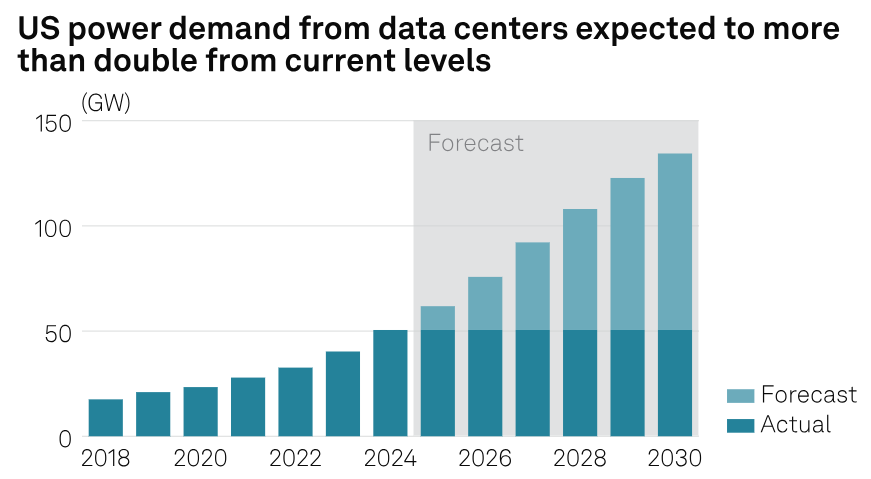
Source: S&P Global Report
Electric grids across the United States were not designed to support today’s pace or density of data center development. While utilities continue to invest in new generation, transmission, and interconnection infrastructure, timelines often extend years beyond the schedules required to bring new data centers online. In many markets, power has become the critical path item, even when sites, buildings, and customer demand are already in place.
AI workloads are introducing higher densities, more volatile load profiles, and far less tolerance for power constraints or delays. Developers are increasingly facing multi-year waits for interconnection, creating a gap between when a facility is ready to operate and when utility power is available.
This gap introduces real business risk. Delayed energization can stall revenue, complicate customer commitments, and limit a developer’s ability to compete in high-demand markets. For operators with aggressive timelines and strict uptime requirements, waiting for grid power alone is often not feasible.
Data center operators are not walking away from the grid. Utility power remains the long-term foundation for most facilities. What is changing is how developers manage the period before interconnection and how they plan for resilience after they are connected.
Firm, on-site power solutions have emerged as a practical way to bridge this gap. These systems allow data centers to begin operations ahead of grid availability, ensuring schedules stay on track and customers are supported from day one.
Once grid power is established, these same systems transition into a secondary role. Rather than being stranded assets, on-site generation becomes a dependable, dispatchable backup that supports reliability, redundancy, and operational flexibility throughout the life of the facility.
A modern power strategy must support the full lifecycle of a data center, from initial deployment through long-term operation. That means planning for temporary independence from the grid while also designing for seamless integration once interconnection is complete.
On-site generation can provide:
This approach allows developers to move forward without compromising future grid integration or operational strategy.
Gray Oak Power was built to help data center developers navigate this exact challenge. The company delivers customized, firm, on-site power infrastructure designed to support early operations and evolve alongside grid connectivity.
Gray Oak works with developers to align power solutions with construction schedules, interconnection timelines, and long-term operating plans. Systems are engineered to perform reliably as primary power when needed, then transition seamlessly into backup or secondary roles once utility power is available.
With deep experience in power generation, development, and operations, Gray Oak ensures these systems are not only delivered quickly but also maintained to meet the reliability standards required by mission-critical infrastructure.
As data center demand continues to rise, power strategy has become a defining factor in project success. Developers who plan only for eventual grid connection risk delays and lost opportunity. Those who plan for both the present and the future gain flexibility, resilience, and control.
Bridging the power gap is not about replacing the grid. It is about ensuring data centers can operate when they need to, scale when they are ready, and remain resilient long after they are connected.Contact Gray Oak Power to get solutions to get solutions to bridge the power gap.